Monday, April 25, 2011

Superstition- A Superstition?

This post would not have been blogged down, had it not been for a post-dinner discussion, a few days back, somehow converging to philosophy. Group A thought that 'Samadhi', a state where a person can live without air, food, water was impossible and shunned it as a mere superstition, whereas, the other group thought that it might be possible. Much contrary to what Science teaches, our ancient scriptures, and the proponents of Yoga* claim that when a person reaches Samadhi, the last stage of Yoga, as mentioned in the Yoga Sutras of Patanjali, the body gets into hibernation and the person can live without food, air, water for infinite time.

* Please note that by the word Yoga, is meant the systematic procedure developed in India for the communion of the soul with the divine. It is, by no means, restricted to Asanas and Pranayama, which form a very small part of Yoga.

If there is one point I would like to make in this post, it is this: it is foolishness, in my opinion, for any person to declare that a certain belief is a superstition just because that person doesn't conceive it. I have never been to the USA. My mere knowledge of the existence of such a country is by virtue of the geography classes I had in High school and the books I read subsequently. It may even be so that the teachers who taught us, have never been to this country themselves. Now, just because I am oblivious of the existence of such a place, what right do I possess to claim that it doesn't exist? If I am to claim so, am I not making a fool out of myself? If I were really contemplative to find out the truth, I would have taken the pain to travel to this land and then deduce for myself. Then alone would I have the right to argue in this matter. Similar is the case with Yoga. I have no right to raise my voice against it unless I follow the conditions laid in it, practice it sincerely and even then, do not obtain the promised results in part or full.

A few people claim that these things are absurd because they cannot be proved by modern science. When a person is hungry, he helps himself to the available food. Does he even bother if Science has proved that food satisfies hunger or not? Does he care to find out what reactions undergo in his body when he eats. He knows from his own experience that food satisfies hunger and that is all that really matters to him at that point of time. Similarly, Yogic practices are based on the experiences of people who strived their entire lifetime and found that it was true. We, common people, do not know if their experiences were true or whether all of them were illusioned to believe so. But still, we have no right, whatsoever, to say that it is mere fallacy. Can we declare that a certain thing does not exist because its presence has still not been proved. Wasn't there a time when Science believed that the planets and the Sun revolved around the Earth? When Galileo tried to prove it otherwise, not only was his idea widely condemned but he was detained for the rest of his life. But now, even a school-going child will laugh at that old idea. It is not right to say that the people of those times were foolish in believing that Earth was the planetary centre. But, in arguing that there could be nothing beyond their ideas, they were indeed foolish to the core. Thus, we conclude from history that even science goes wrong at times. Even those hundreds of theories which were widely accepted yesterday, as the ultimatum, are being dismissed as utterly wrong, today. I would like to bring to your notice that, of late, many yogic theories are being proved and accepted by modern science. [I shall make an attempt to pen down some of them in my future posts.] After all, is science the ultimatum? Can there be nothing beyond science? Aren't there numerous happenings in the world that defy science? There are times when a scientist dismisses a certain idea as false just because his set of laws, which he calls modern science, cannot prove it. Doesn't this also suggest that his set of laws are very limited and needs to be consolidated. Verification is also an acceptable proof for any theory. As in many accepted facts of Science, Yoga's sole proof is in its verification (as claimed by the exponents of yoga). But, as the yogis themselves opine, it is a herculean task to achieve the goals of Yoga. Our world has seen many saints, in India and beyond, who claim to have reached the goals of Yoga. There could be some truth in it, or, it may be another heap of nonsense. I don't mean to say that we need to accept it just because certain people said so. Let us follow it and find out for ourselves. But if we do not will to verify, and yet criticize it, then in what way are we different from the 'foolish frog of the well'? The same applies to all other practices which are mocked in the name of superstition. Perhaps, many of them really are. But it is not wise to reject everything as superstition.


Again let me make my point clear if my post has not, unfortunately, already done. I do not support accepting something merely because it was said so or certain people believe so. But at the same time I consider it foolishness to discard something as superstition just because it does not fit in our ideas. Let us try our best to dig out the truth from it and then accept it or reject it. But before we make a sincere attempt, we have no right to shun it. In my opinion, both are equally irrational- the ones that blindly accept something and their counterparts, the ones that blindly reject something as superstition without any justification. In that context, isn't Superstition itself a Superstition? To the people who mock our practices as superstition, our sages would say "Look, your world in itself is a superstition". This being said, I dedicate my upcoming posts to some practices considered superstition, which in reality are in very much agreement with modern science. Again, as already declared in my maiden post, if any thing fails to convince you, it is solely because of my poor convincing skills rather than due to the insignificance of the actual topic under consideration.


Wednesday, January 26, 2011

SewaKunj

Swami Vivekananda had exclaimed, "If the poor cannot come to education, education must go to them". The Sewakunj Ashram of the Akhila Bharatiya Vanavasi Kalyana Ashram is in the endeavour of bringing this dictum to practice. I was highly fortuitous to celebrate republic day here, and, justice is not done if a post in this blog is not dedicated to Sewakunj.

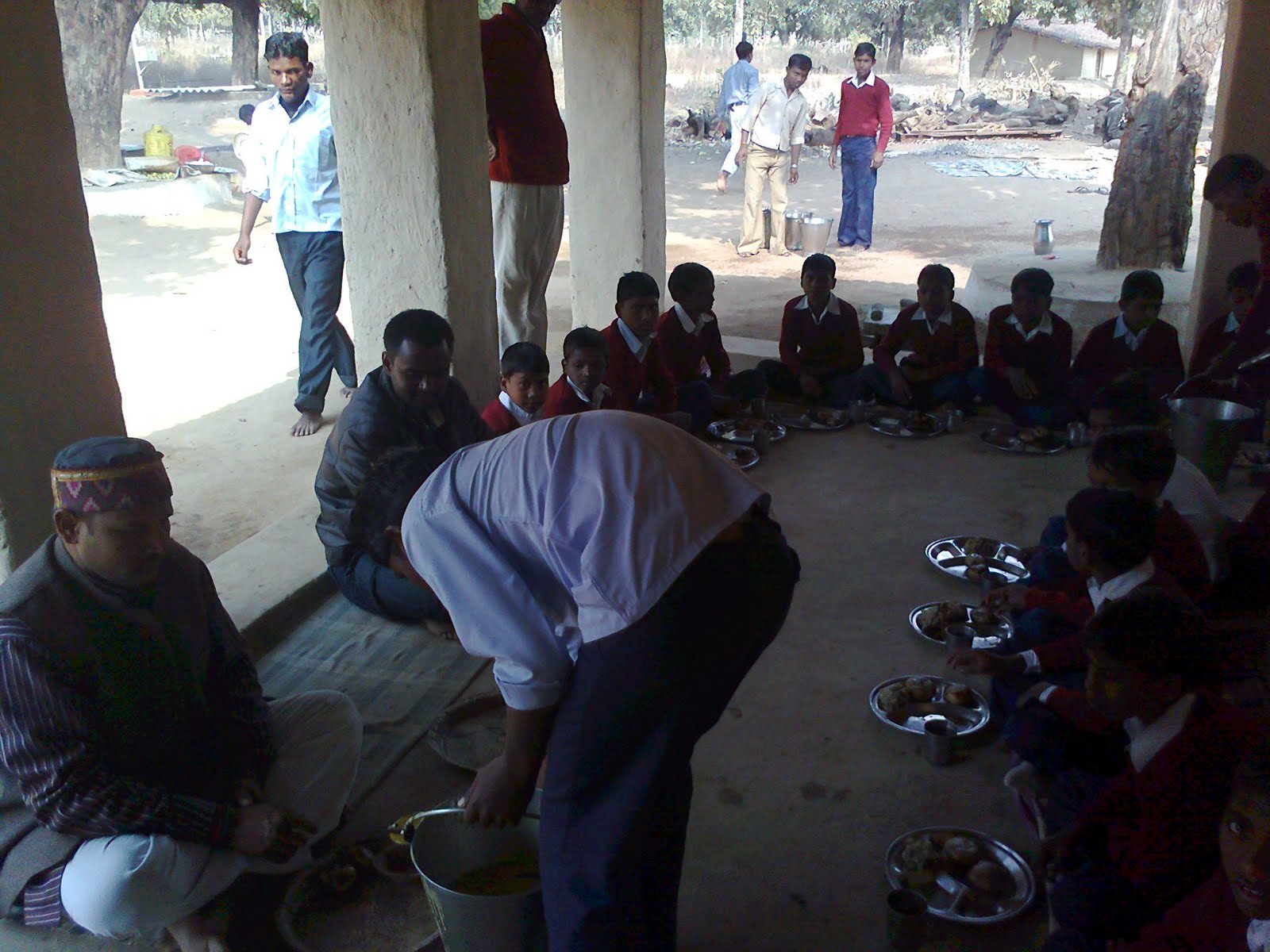
Not very far from Varanasi is a district (in Uttar Pradesh), Sonebhadra, that is home to a large number of tribals. Notwithstanding its vicinity to this ancient city which is considered to be the seat of learning, the number of poor illiterates in this district has reached shocking figures, the literacy rate among the people being only around 40%*. Despite the vast industrial development in this region, the economic conditions of people have hardly improved. To most of the poor tribals, getting 2 square meals a day is the greatest comfort they can ever think of. For many parents, education of their children doesn't seem more worthy than the petty rupee notes that their children earn if they are sent out to do odd jobs. Thus, convincing the parents that education of their children was more important, was by itself a herculean task. Owing to the persistent efforts of a group of philanthropists the SewaKunj Ashram was setup in 1998, at a remote place- Chapki, situated nearly 200 kms from Varanasi. Ever since, Sewakunj has been catering to the educational needs of poor students of this area. The students are given not only quality education totally free of cost, but are also given free accommodation and food.

( A routine class)**

At sewakunj, the day dawns at 4 a.m. After offering their routine prayers, the students assemble in the classrooms for their lessons. The students, almost 65 in number, belong to classes 2-9. Sewakunj caters to classes upto 6, whereas the remaining students have to attend classes at a High school about 7 kms from Sewakunj. The children cook food for the ashram, in turns and also take care of the cleaning and other activities at the ashram. They are also engaged in music, dance, gardening and sports like football, archery etc. It is indeed an appreciable achievement that every year, 10-12 students from here get selected for Training in Archery by the National Sports Authority of India. Some students also succeed in obtaining seats for B. Ed and Engineering.
(The students cook food on rotation basis)**

(Republic Day Celebrations - 2011 )
Thus says the elderly Mr. Veerendra Narayan Shukla, one of the important member in the group, "We have taken the help of the government in the setting up of the ashram. However, our recurring expenses are managed solely using the generous funds collected from people". He adds, "people are ever ready to contribute, provided that the right use of their money is guaranteed". Indeed, of what better use can money be put to, than educating a poor child!
(Lunch being served)

Mr. Anand, who is the person responsible for the smooth running of the ashram seems to have a wonderful rapport with the students. Mr. Shantakumar, an enthusiastic social worker and Engineer at NTPC, opines that, "This is also a silent, positive war against Naxalism. People who joined naxalism with a sense of adventurism, now want to exit. They themselves cannot come out, so they desire that at least their children should have a better life. Such avenues give them a way for better life".
(The students enjoy doing odd jobs in the ashram)**

Here, nothing could be more appealing than the discipline of the kids. In contrast to modern education, where money is the driving force, in Sewakunj, it is Discipline and Moral upliftment that finds more importance. I am of the firm opinion that our education system shall fare better if its prime focus is shifted from money to intellect and discipline. I hope that in the years to come, Sewakunj shall brighten the lives of more deserving students and that it shall be a benchmark for other organizations working towards the same goal.
(Archery @ Sewakunj)

Readers are requested to also visit the blog of the Ashram.


* As per the data issued by the govt. of Uttar Pradesh based on 2001 census.
** Image Courtesy of Mr. Shantakumar.

Friday, January 22, 2010

Netaji..

The history of India has seen great Heroes who laid down their lives for the Liberation of the Country from British Tyranny. Beyond doubt, the role of Subash Chandra Bose in reviving India's lost Freedom, is highly significant. Rightly called the "Netaji", Bose was highly feared by the British Rulers. Subhas Chandra Bose's eloquence and unmatched Courage had won him thousands of followers. His words- "Remain faithful to India, and do not, for even a moment, waver in your faith in India's destiny", even today, cause great sensation in the young and the old, alike.

Born on 23rd Jan, 1897, Bose was strongly influenced by the teachings of Swami Vivekananda, like many of his contemporaries, and he accepted him as his Spiritual Guru. In 1916, Subash Chandra Bose thrashed a British Professor by name, F E Otten, who had made racist comments against Indians. This marked his entry into India's freedom struggle. Though he stood Fourth in the civil services exam, which enabled him work as a civil servant of India (under the British, though), he had, by then made up his mind to not serve the British in any way. He immediately returned to India and joined the Indian National Congress. He was strongly influenced by C. R. Das, another freedom fighter, whom he accepted as his Political Guru.

When in Vienna, he happened to get acquainted with Vittalbhai Patel, who was very much impressed with Bose's plans for India. Together they chalked out schemes of bringing the British tyranny to international notice and gaining the support of anti-British Nations. He then visited various foreign nations, and held discussions with eminent political leaders. While still abroad, he was elected as the President of the Indian National Congress(INC). As Bose would resort to aggressive methodologies, he was often in altercations with the non-aggressive leaders, who, unfortunately, formed the majority. Despite Gandhi's opposition of his re-election as the President, he got successfully re-elected as the President of the INC defeating the Gandhi-supported candidate Dr. P. Sitaramayya. Considering the possibilities of a world war breaking out, he brought out a proposition forcing the British to grant India independence within 8 weeks. But, owing to protests from Gandhi and his supporters, he resigned from the post of the President, saying that he didn't have any desire to be a "dummy president". He then founded the Forward Bloc party, and as world war broke out, he was arrested by the British and then put under "house-arrest". In spite of the tight security, he escaped to Germany. It is in Germany that Bose founded the Azad Hind Fouj, which later on came to be known as the Indian National Army(INA). He was wrongly labelled as a Nazi by the western media. However, it is clear from the evidences of history that his support to the Germans was limited to their fight against Britain. He not only 'Not supported' the Nazis but was also involved in Anti-Nazi activities. Seeing that defeat was inevitable to the Germans, he moved to South East Asia, on the lookout for better options of liberating India. He joined hands with two other influential leaders, Ras Behari Bose and Captain Mohan Singh in Singapore, and with their help strengthened the INA. He allied with the Japanese, and succeeded in acquiring the Andaman and Nicobar islands to the Provisional Govt. of India, setup by him. In 1944, the INA, commanded by Bose attacked India from the Burmese border and successfully captured a significant part of Indian Territory. However, owing to extreme climatic conditions prevalent, the INA had to retreat. Following the defeat of Japan to the allied forces of the British, the INA was left with no choice. History has it that, on August 17, 1945, the plane with Bose on board, crashed, thereby killing him. On the contrary, many historians claim that it was not Bose who was aboard. Many even allege that he lived incognito, for many decades after independence. However, owing to lack of evidence, nothing is certain in this issue.

Bose played a very important role in awakening the youth of the country and moulding them into great leaders. He shall always be remembered as a man of infinite Courage and will. It is highly unfortunate that Bose could not live to see India Independent (assuming the official statement of his death to be true, as a last resort), but his ideals shall eternally live in the hearts of every Indian. Hats off to Netaji!!!

Tuesday, January 12, 2010

The cyclonic monk of India...

"Sisters and Brothers of America".....This magical assortment of words, solely with the aid of which, a great Indian Sanyasin had conquered the hearts of the not-so-easy-to-conquer Americans, at a time, when the the people of India, which is considered the mother of religions, themselves had lost hope in religion. This great man, Swami Vivekananda, who, even a century after his exit from "our-world"(Mahasamadhi), continues to motivate millions of people, directly or otherwise and therefore needs no introduction. Any blog on India is not complete without delving into the teachings of Swami Vivekananda, who was rightly called the "Cyclonic monk of India" or the "Patriotic Monk of India". Today being the birthday of Swami Vivekananda, it is time to fulfill my long-awaited wish of penning a post on this sage. Therefore, the next few posts (in addition to the current) shall be dedicated to Swami Vivekananda.


This sage who had not a penny in his possession, nor a "popular-name", upon repeated persuasion from his devotees in India, the Maharaja of Rameshwaram being notable among them, sailed to the USA, to attend the "Parliament of World Religions" to be held in Chicago.
Swamiji, who was stolen off all his little possessions, soon after his arrival in Chicago, was invited by the few kind-families of America, in turns, to take shelter in their homes. The organisers of the Parliament of Religions, had plans of letting only delegates with bonafide credentials to participate. Little did they know that here was an effulgent man ready to conquer the world with love. An eminent professor from the Harvard university, who, awestruck with his association with the monk, is said to have exclaimed (and written to the Chairman), "Here is a man who is more knowledgeable than all our professors put together. To ask Swami Vivekananda for credentials is no different from asking the sun, its right to shine". Thus Swamiji was entitled to participate in the World Parliament of Religions.

Initially nervous, as he had never addressed a public gathering before, he opted to be the last of the delegates to deliver his speech. In response to his starting words, "Sisters and Brothers of America", believe it or not, the crowd, over 7000 in number, responded with a full three-minute-long standing ovation with thunderous clapping. It is indeed amazing that Swamiji earned such a rapturous response, that too, having uttered less than half a dozen words. Moreover, it is a clear indication of the abilities of Swamiji. Many claim that it is merely the usage of the words "Sisters and Brothers" which made the crowd rise in joy. Little do they understand that the same words had been used extensively in the earlier part of the parliament of religions, by almost every other speaker. What then, made this crowd give the kind of the applause they did, that too for the mere 5 words uttered by this man, that all the remaining speakers put together had not earned for their complete speeches? The answer lies in the deep-love and the compassion Swamiji had for humanity. This historic event made Vivekananda a (True) Hero, overnight! The newspapers, the following day, were flooded with lines in praise of this "Orange Monk". The Newyork Times remarked thus, "Vivekananda is indeed the greatest figure in the parliament of religions. After hearing him we feel how foolish we had been in sending missionaries to this learned land." As a result of the amazingly huge number of followers that he had gained, he had to spend four years, lecturing in America.

Swamiji used to say, "The west has solved the problem of how much a person can have, and we (in India) are trying here to solve the problem of how little a man can have". Very much true indeed!. On one occassion, referring to the Christian missionaries funded by the British government, he burst forth, "Let England teach us the fine art of government, for in that art Britain is the leader of the nations, let America teach us agriculture and science and your wonderful knack of doing things, for here we sit at your feet; but let no nation presume to teach India religion, for here India shall teach the world."

Till his last breath, Swamiji tried to revive the lost glory of India. His fire-like words greatly inspired the youth of India, to plunge into the freedom struggle. No wonder, leaders like Subash Chandra Bose, Mahatma Gandhi dedicated their lives for India's freedom from the british, having been motivated by the teachings of Vivekananda. Perhaps, Swamiji's love for the country, shall never have a match, nor shall he. Upon returning from the west, he brushed the Indian soil on his head and exclaimed, "India I loved before I came away. Now the very dust of India has become holy to me, the very air is now to me holy; it is now the holy land, the place of pilgrimage, the Tirtha!".


Swamiji had immense love and respect for his Guru, Shree Ramakrishna Paramahamsa. He describes his Guru, in a discussion with Shree Yogananda thus, "Thousands of Vivekananda's may spring forth through one gracious glance of his (Shree Ramakrishna's) eyes". Indeed, it is harder to even estimate the greatness of this holy master, who was totally responsible for blessing this world with Vivekananda.

Lord Shree Krishna asserts in the Gita,


I come, and go, and come. When Righteousness Declines, O Bharata! when Wickedness Is strong, I rise, from age to age, and take Visible shape, and move a man with men,

(http://sacred-texts.com/hin/gita/bg04.htm)

Swami Vivekananda's life stands in support of this. India is blessed a million-times-over by the birth of Swami Vivekananda. Vivekananda's life itself is a vindication to the world, of the fact that "India is the only country which never went outside of itself to conquer" and that the contribution of India to the world shall always be, great teachers who conquer by love rather than barbarians who conquer by power.


Saturday, October 17, 2009

The doctor with a hole..

In India, wearing ornaments has been a custom, especially for women, since time immemorial. In fact, sculptures from the Indus-civilization-era too depict women wearing bangles and various other ornaments. Naturally, ornaments play an important role in augmenting the beauty of a human being. However, most of us fail to understand that these traditional ornaments have more to do, than simply rendering 'physical' glitter.

In India, Bangles are generally worn by women of all sects and age. As all of us, probably, already know, bangles are metallic or otherwise, worn around the wrists. These are so designed that, they are neither too tight to fit in one place, nor too loose to slide out of the arm. It must be noted that the theory of Accupressure (more on this in a later post), which is known to cure even dangerous diseases as AIDS, locates precisely 6 points on the wrist, which are associated with reproductive organs. In other words, applying periodic impulses of pressure at these points, can not only enable keeping these organs in shape, but also cure any ailments pertaining to the same. The movement of the bangles around the wrist, apply accupressure treatment on these points, thereby ensuring that the reproductive organs are in order. Bangles have, therefore, been silently doctoring the health of the millions of women who wear them. In villages, it is common for women to wear other ornaments like nose-rings etc, which serve similar purposes. It is not surprising that, there is also a tradition in India, to shatter the bangles of women, following the death of their husbands. It is truly incredible, how our customs have so much science embedded in them.


PS: Being an Electrical Engineer myself, I can't help guessing that the 'metallic' bangles have something to do with the induction of voltage and thereby current (as they are closed), to interact with the magnetic and electric fields, which are produced by the human body.

Friday, October 2, 2009

Jai Jawan, Jai Kisan...A tribute to the true gem of India

While the entire world is celebrating the Birthday of Mahatma Gandhi, one person continues to remain backstage. He is the most humble, sincere, honest (the list is endless) Prime Minister India ever had (and perhaps, will ever have). On his birthday, this post is a tribute to Lal Bahadur Shastry, who despite his selfless service to the nation, is more-or-less forgotten by us.


Born on 2nd October, 1904 in Ram Nagar, Ahmedabad, Shastry immersed himself into the freedom struggle at a very tender age. He spent nearly a decade in jail, for various reasons. Perhaps the following 3 incidents suffice to depict the sincerity of Lal Bahadur Shastry.


When he was the Prime Minister, a poor man somehow managed to sneak into his office. Claiming that it was his daughter's wedding and that he was too poor to make the arrangements, he demanded financial help. Shastry, however, politely made known his inability to be of any help, pointing out that his bank-balance was only Rs 60 (the minimum amount to be in a bank account was then Rs 50). Not convinced(who would be? considering the huge fortunes our politicians have amassed), the poor man continued to urge him. Finally, he announced to Shastry that he would go and ask Mrs. Shastry for the money, and left his office. When Mrs Lalita Shastry heard his hue, she took no time to give him the only Rs 100 which she had in her possession. When Lal Bahadur Shastry learnt about this from the poor-man, he was shocked as to where she would have gotten this money from. When he questioned her, she told him how she had saved the money, rupee by rupee, from what money was given to her for groceries. The very next day, Lal bahadaur Shastry is reported to have written to the then President of India, requesting to reduce his salary by an amount of Rs 100 as he no longer felt it necessary. This letter still exists in official records, as a proof of the sincerity of Shastry.


Once, when Shastry was out for a walk, some ruffians, bribed by some adversaries, to insult him, got hold of Shastry by his collar and threatened him. They continuously questioned him as to what good he had done to this nation. Shastry did not lose temper. Pointing at the hands gripping his collar, he humbly replied, "You see. Today you are free to get hold of the PM by his collar. This is the good I have done to India"

On being questioned by a friend, who seemed worried about Shastry not getting due credits for his accomplishments, Shastry replied "I would like to be the hidden-stones of the foundation, that support the Taj Mahal rather than the ones rendering beauty to it".

Shastry, who was unanimously elected the Prime Minister of India in 1964, regardless of the then pathetic economic condition of India, within a span of less than two years, achieved self-sufficiency of food-grains thereby bringing about the 'Green Revolution'. He is known to have introduced various (working) schemes for the farmers.

He was a perfect example for the old English proverb- "Filled vessels make no noise". Simple, humble by nature and at the same time daring, he did not think twice when the Pakistan army took pleasure in attacking the borders of India( Indo-Pak war, 1965). Within a short span of time, the Indian army not only succeeded in causing the Pakistan army to flee from our land, but also captured every square kilometre of land up-to Lahore. Had it not been for the intervention by U.N.O., Pakistan would not have lived to see this day. Shastry who had been to Tashkent to sign an agreement with the Pakistan PM, died a "Natural death" on 11th January, 1966. He was awarded the Bharata Ratna postumously. The whole life of Shastry is an ideal. Hopefully, one day our Politicians will learn a lesson from the life of Shastry.


Wednesday, September 16, 2009

"Speed of Light" in the Rigveda...

[ This post aims to dwell on yet another evidence for the brilliance of the ancient Indian Astronomers. ]

It was not until early 17th century that man had a clear-cut idea about the behaviour of Light. Many models to study light were then proposed, however, owing to the non-trivial behaviour of light, none of them survived for long. Isaac Beeckman, Galileo Galilei failed in their onerous experiments to measure the speed of light accurately. Their findings nevertheless zeroed down most of the myths about light. Finally in the year 1879, Michelson with his experiment using mirrors, obtained an estimate of the speed of light, which is accurate enough to be considered for all astronomical or otherwise calculations.

But what astounds me is that there exists a shloka in the Rigveda which says,

" तरणि: विश्व दर्शतो ज्योतिश्कुदसि सूर्य |
विश्वमाभासी रोचनम "

"The sun quickly pervades the whole world."

Sayanacharya (a celebrated saint) comments on the above text thus,

"तथा च स्मर्यते योजनानां सहस्रं द्वे द्वे शते द्वे च योजने एकेन निमिशार्धेन क्रममाण नमोऽस्तु ते इति"

"It is to be remembered that the sunlight travels 2,202 yojanas in half a nimisha"

On converting the various units to our modern units, we get the speed of light to be 1,85,016.169 mile/s which is very close to the modern value of 1,86,000 mile/s ( now which of these is more accurate is again a debateable question ).

It is to be noted that the composal of the Rigveda dates back to 1700 BC, long long before Modern-Science even knew what light was.


Acknowledgement: The shlokas and translations penned down in this post are a more-or-less reproduction of the "Speed of Light" article in the "Science in Sanskrit" book published by "Samskrita Bharati". Readers are hence requested to check out the original book here.